The bigger picture
What is net worth, and how do you calculate it?
Net worth is what you own minus what you owe. How to add yours up, what to leave out, why it can start below zero, and why the trend matters most.
Your net worth is everything you own minus everything you owe. It’s a single number, and it answers a question a budget can’t: over months and years, are you getting ahead?
What it is
Net worth = what you own − what you owe.
That’s how FINRA, the group that oversees brokerage firms in the U.S., explains it too: add up what you own, then subtract what you owe.
What you own includes cash, checking and savings, retirement and investment accounts, and things you could sell, like a home or a car. What you owe includes credit card balances, student loans, a car loan, a mortgage, medical bills, and anything else you’re paying off.
Say you have $8,000 in checking and savings and a car worth $6,000. You owe $2,000 on a credit card and $15,000 in student loans. You own $14,000 and owe $17,000, so your net worth is −$3,000.
Don’t panic if yours comes out below zero. Early on, a student loan can be bigger than everything you own. What matters is which way the number moves.
Why it matters
Net worth shows progress that a budget can’t. A budget tells you about this month. Net worth tells you whether the months are adding up to something.
It counts paying off debt. Paying $500 off a loan doesn’t feel like saving, but your net worth goes up by the same $500 as if you’d put it in the bank.
It also catches slow leaks. Spending a little more than you earn each month won’t jump out of any one month’s budget, but it shows up as a net worth that slowly drops.
Your own trend tells you more than any comparison. Measuring your number against a friend’s, or a headline’s, doesn’t tell you much. Measuring it against your own number from six months ago does.
How to do it
1. List what you own
Use today’s balance for every account. For a retirement or investment account, use what it’s worth today. For a home or a car, use what it would really sell for, not what you paid. If you’re not sure, leave something like a car out. A number that’s a little low is more useful than one that makes you feel good.
Don’t count everyday things like furniture or clothes. You can’t easily turn them back into money.
2. List what you owe
Use the full amount of every debt, not the monthly payment. That means the whole credit card balance and the whole loan.
3. Subtract
Take what you own minus what you owe. Write the answer down with the date.
4. Do it again the same way
Once a month or once every three months is plenty. Use the same rules each time, like whether the car counts, so the change from one date to the next means something.
How to do it in Simple Balance
Simple Balance works as a net worth tracker. Once every account is in it, one report adds them all up for you.
Add every account
On Accounts, press New account for each account you have, including the ones that hold debt. For a debt, choose Credit card or Loan. Type what you owe as a plain number and leave Starting balance type on Amount owed. The account starts below zero, which is exactly how it counts toward your net worth.

The money in this picture is made up. It’s the real product, filled with example spending.
Read the report
Reports has a Net worth report that adds up what your accounts hold and what they owe. Group it by month or by quarter to see the trend, not just one number.

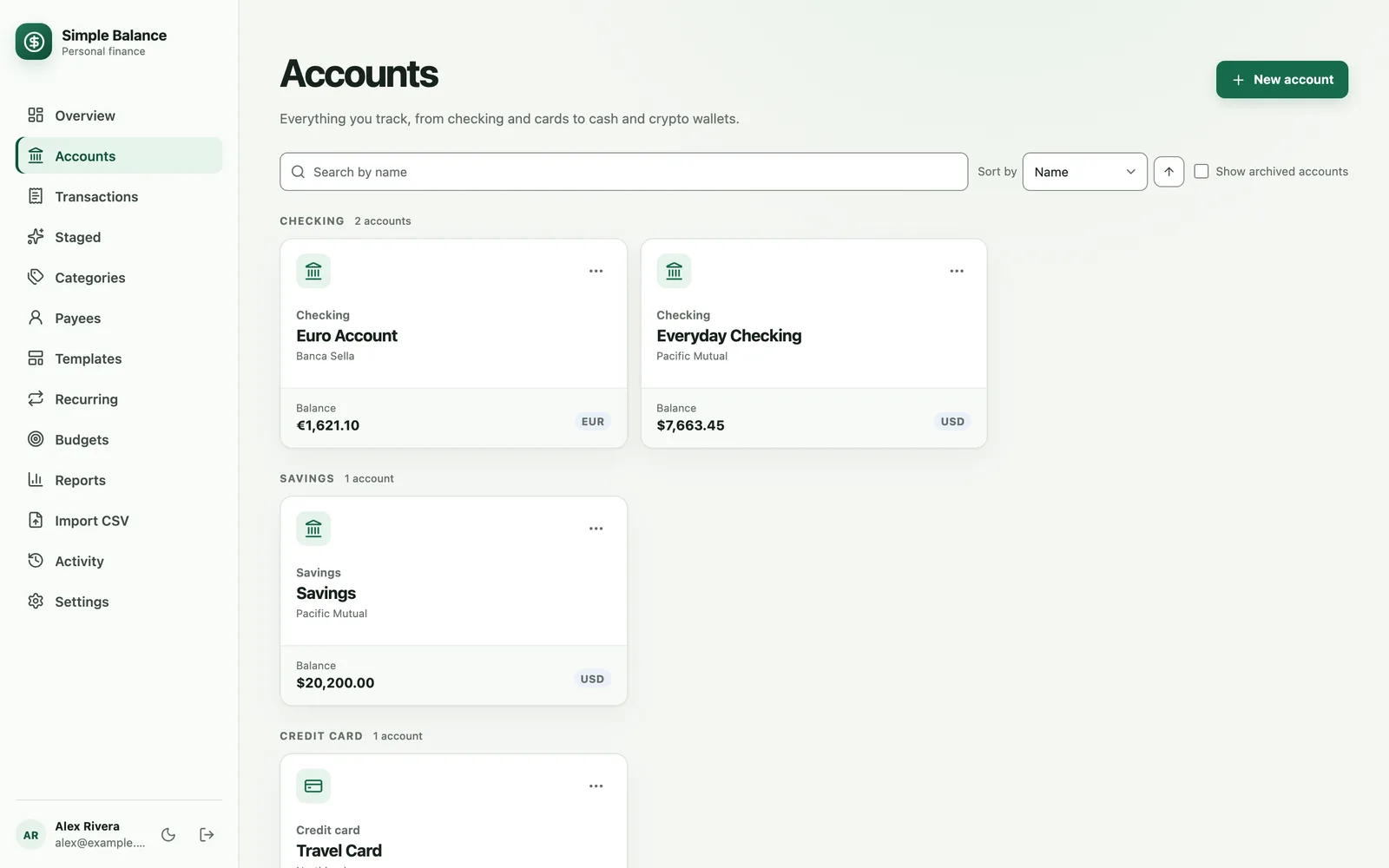
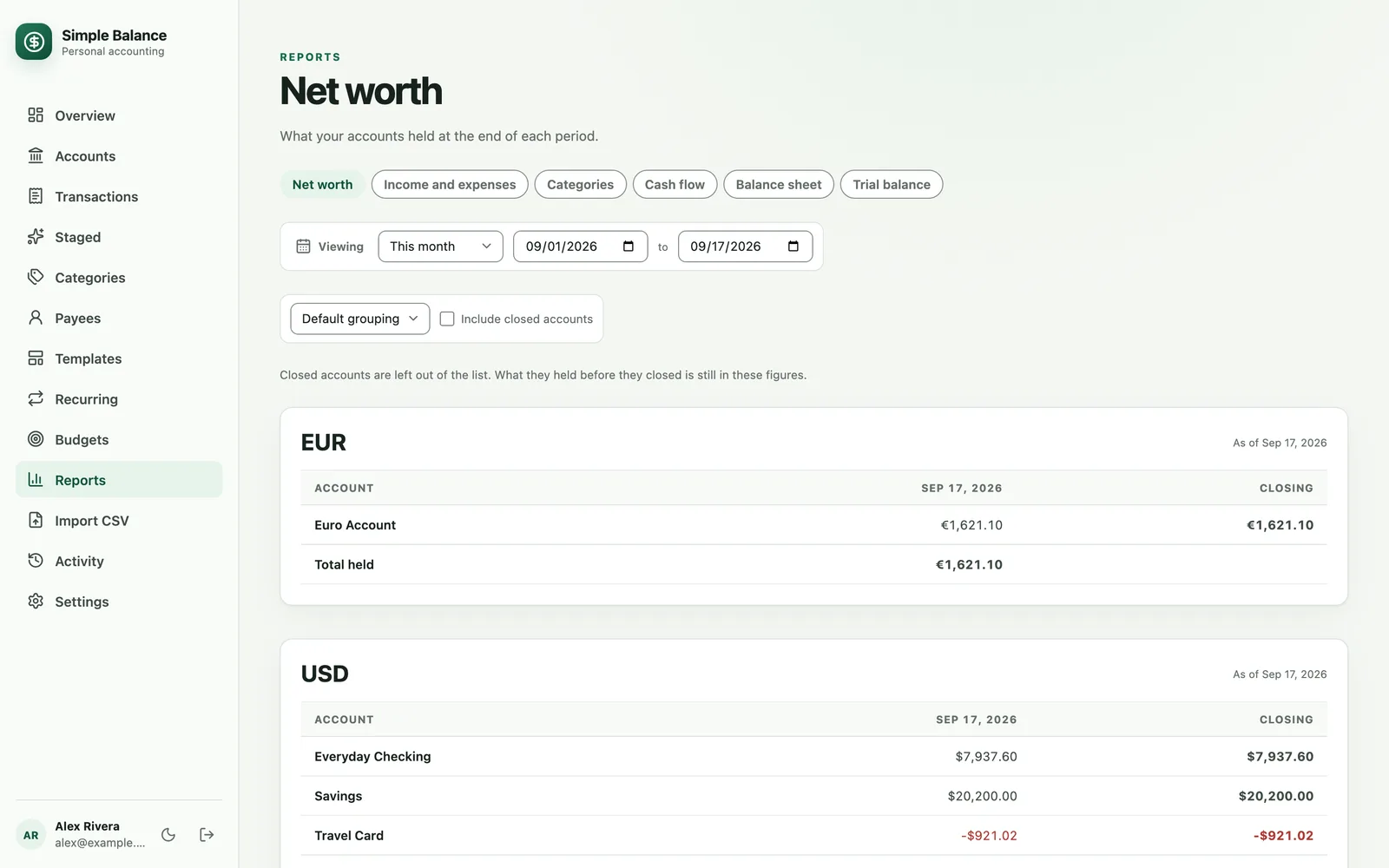
The money in this picture is made up. It’s the real product, filled with example spending.
More than one currency
If you have money in more than one currency, Simple Balance totals each one separately and never converts between them. Any exchange rate it picked would be out of date by tomorrow.
Things it can’t put a price on
Simple Balance doesn’t look up what investments, a home or a car are worth. You can keep them as accounts of type Investment or Other asset, but their balances are only as up to date as the last value you entered. You can also track just your cash and debts here and leave the rest out. That’s a fine net worth to watch, as long as you count it the same way every time.
Accounts you’ve closed
You can archive an account you’ve closed from its row menu. Its history stays there for you to read, and its balance stops counting toward your totals.
Sources
- FINRA. Financial Foundations.
- Board of Governors of the Federal Reserve System. Federal Reserve Board releases results of the 2025 Survey of Consumer Finances. Press release, October 9, 2026.
- Board of Governors of the Federal Reserve System. Changes in U.S. Family Finances from 2022 to 2025. October 2026.