Recurring transactions
Set up rent, pay or a subscription once. On each due date a row waits on Staged for you to check and commit, with an email if you want one.
A recurring transaction is a rule for money that moves on a schedule, like rent, a paycheck or a subscription. On each due date it puts a row on Staged for you to check and commit. It never adds anything to your books on its own.
What it does, and what it doesn’t
The row it puts on Staged is an ordinary staged row. It doesn’t count toward any balance, budget or report until you commit it, and you can change it or delete it first, like a row from an imported statement.
That’s on purpose. A bill that changes every month can wait for you to type in the real amount, instead of being recorded wrong. And if the schedule ever stops running, the Recurring page says so, instead of months of rent quietly going missing from your books.
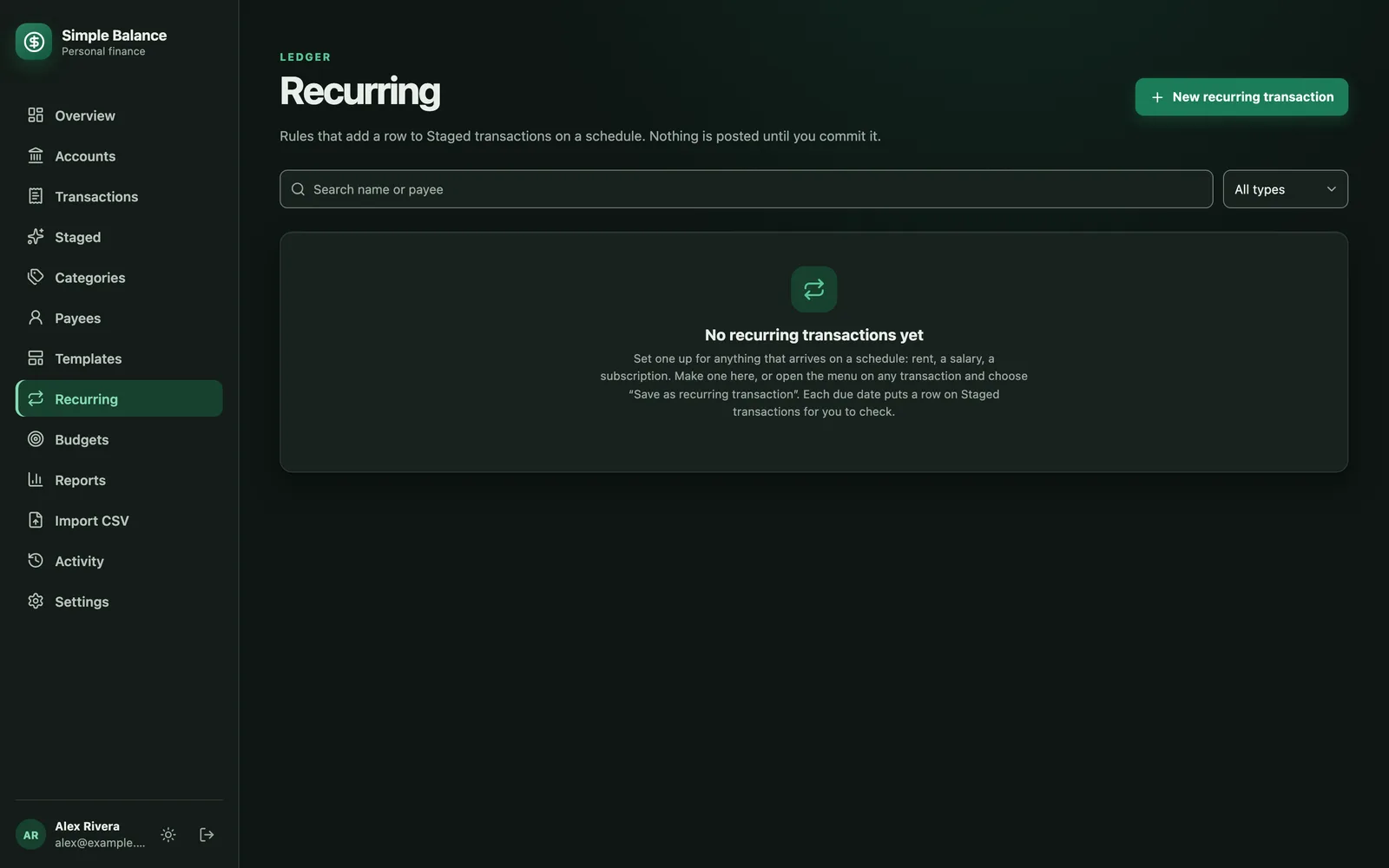
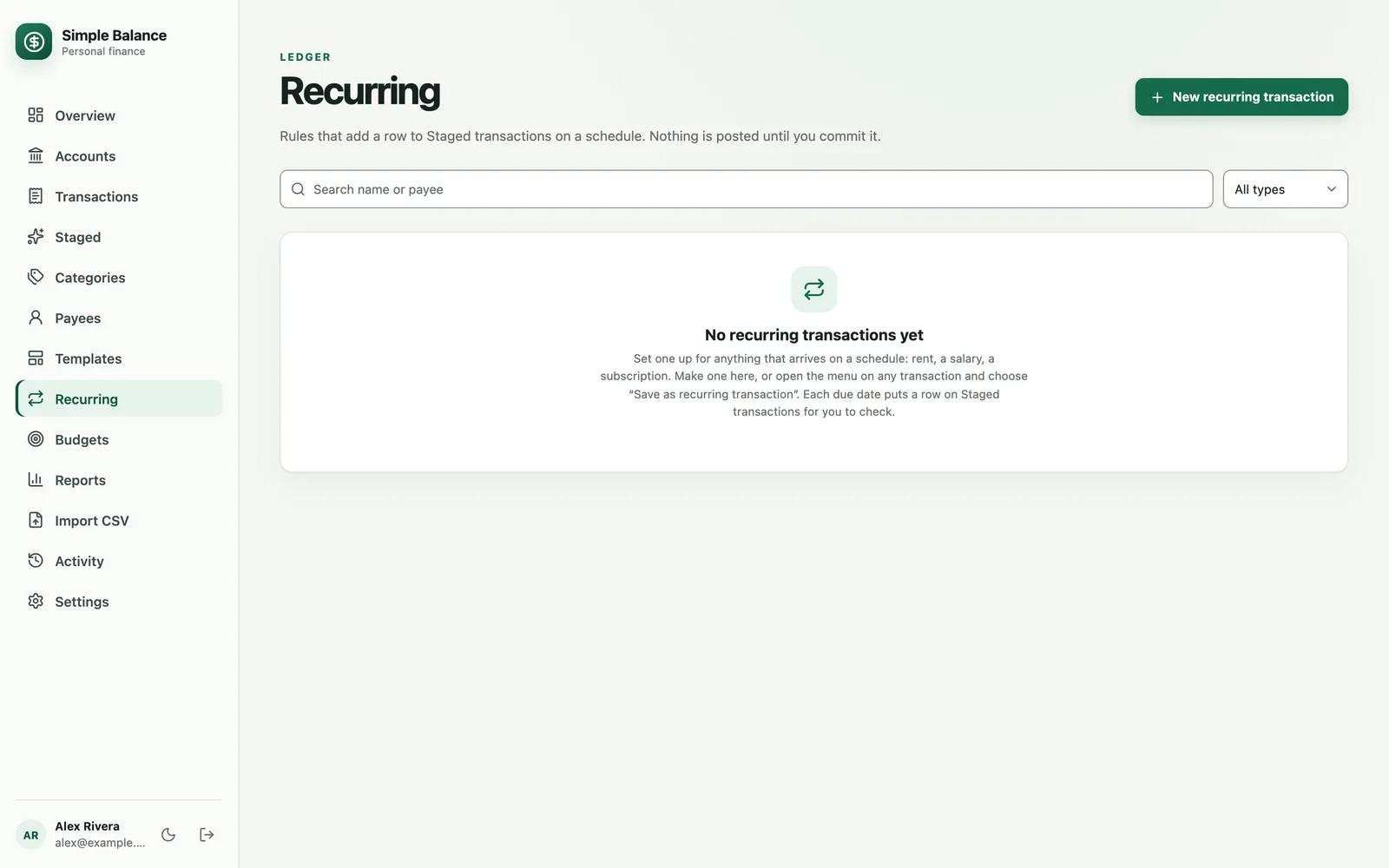
The money in this picture is made up. It’s the real product, filled with example spending.
For something you enter by hand with no fixed date, a template fits better.
Set one up from a real transaction
Starting from a payment you’ve already recorded is the quickest way, and it gets the day right.
- Find the transaction on Transactions, on an account, category, payee or template page, or on Staged.
- Open its ⋯ menu and choose Save as recurring transaction.
- Give it a Name.
- Check the schedule. The transaction’s date becomes Starting, so a rent payment dated the 1st repeats on the 1st.
- Check the Next five dates, then press Create recurring transaction.
It keeps the transaction’s type, payee, account or accounts, amount, category or split, description and notes. It leaves out the date, the bank’s own reference on an imported row, and the amount received on a transfer between two currencies, since an exchange rate changes from one time to the next.
Set one up from scratch
- Open Recurring and press New recurring transaction.
- Fill in the fields below.
- Choose a schedule.
- Press Create recurring transaction.
| Field | What it does |
|---|---|
| Name | Required, up to 120 characters, and different from your other recurring transactions’ names, ignoring capitals and spaces. A name you’ve already used gets “A recurrence with this name already exists”. |
| Type | Withdrawal, Deposit or Transfer. It starts on Withdrawal, and unlike a template it can’t be left out. |
| Payee | Required. |
| Account, or From account and To account | Required. A transfer needs both. |
| Amount | Optional. Leave it blank when it’s different every time, and each row waits on Staged for a number. On a transfer between two currencies it’s called Amount sent. |
| Amount received | Only on a transfer between accounts in different currencies, and optional. See Between two currencies. |
| Category | Optional. Split across categories divides it, and a split has to add up to the amount, with a category and an amount on every part. A name you don’t have yet asks what kind of category it is, such as Money you spent or Paying back money you earned. |
| Schedule | How often it comes around. See Choose a schedule. |
| Description, Notes | Optional. |
| Notifications | Email me when this proposes a transaction. See Email reminders. |
Create recurring transaction stays off until the form is complete, and says the first thing that’s missing, such as “Enter a payee.” or “The split has to add up, and every leg needs a category.”
Choose a schedule
| Option | What it does |
|---|---|
| Repeats | Daily, Weekly, Monthly or Yearly. |
| Every N months, or days, weeks or years | How far apart, from 1 to 366. 1 means every one. Weekly every 2 is every other week, and Monthly every 3 is once a quarter. |
| Starting | The date the schedule starts from, and the one every later date is counted from. A weekly schedule repeats on this date’s day of the week, and a yearly one on its month and day. |
| Day of the month | Monthly and yearly only. On day N of the month uses the day of Starting. On a relative day asks for Which one (First, Second, Third, Fourth or Last) and a Day of the week. |
| When the month is too short | With On day N of the month, for a day some months don’t have, such as the 31st. Use the last day of that month or Skip that month. |
| When it lands on a weekend | Propose it on the weekend, Skip it, Move it to the Friday before or Move it to the Monday after. |
Under the schedule, Next five lists the next five dates. A date a weekend rule moved says “moved from” the date it would have been, and a date that’s skipped says “skipped”. Check it before you save.
Some details that matter:
- Dates are counted from Starting, never from the last date. A schedule on the 31st set to Use the last day of that month lands on February 28 (or 29) and is back on March 31, instead of drifting to the 28th for good.
- There’s no fifth Friday, or fifth anything, because some months don’t have one. Use Last.
- A business day is Monday through Friday. Holidays aren’t counted, so a row can land on one.
- Only the row’s date moves. A weekend rule changes the date on the row it proposes. The next date is still counted from Starting, so the schedule never drifts.
- A daily schedule every 1 or 2 days can’t use the Friday or Monday options, because moving a date would put two rows on one day. Make it every 3 days or more to use them.
Examples
| What you want | Repeats | Every | Starting | Also set |
|---|---|---|---|---|
| Rent on the 1st | Monthly | 1 | A 1st | On day 1 of the month |
| Pay every other Friday | Weekly | 2 | A payday Friday | Nothing else |
| Pay on the 15th, or the Friday before on a weekend | Monthly | 1 | A 15th | Move it to the Friday before |
| Pay on the last business day of the month | Monthly | 1 | A 31st, such as January 31 | Use the last day of that month and Move it to the Friday before |
| A bill on the second Tuesday | Monthly | 1 | A day in the first month | On a relative day, Second, Tuesday |
| A yearly renewal | Yearly | 1 | The renewal date | On day N of the month |
For the last business day, check Next five: each date should be the last weekday of its month, with “moved from” beside the ones that fell on a weekend.
Bills that change every month
Leave Amount blank. Each row then arrives on Staged marked Needs attention, with the note “This recurring transaction does not set an amount. Fill one in before committing.” Type in the amount from your bill and commit it.
A recurring transaction with no amount can’t be counted in the forecast on Budgets, which names it. See Planning ahead.
Between two currencies
For a transfer between accounts that hold different currencies, the form asks for Amount sent and Amount received. Leave Amount received blank and each row waits on Staged for it, which is what you want while the exchange rate moves. Fill it in only when the rate is agreed in advance, since every row will then use that same figure. More than one currency has the rest.
What happens on the due date
- On the day it’s due, in your own timezone from your preferences, a row appears on Staged dated that day. Under its payee it says which recurring transaction proposed it and for which date.
- A weekend rule changes the date on the row, not the day it arrives. A Saturday payment set to Move it to the Monday after arrives on Saturday, dated Monday.
- Nothing dated before the day you set it up is ever proposed, even if Starting is earlier. So setting up rent on the 10th with Starting on the 1st proposes next month’s rent, not this month’s.
- Like any staged row, it’s checked against your books, and a row that looks like a payment you already have is flagged as a possible duplicate.
- A row naming an account or category you’ve archived or deleted since arrives marked Needs attention, with a note saying which.
- It shows in Activity history as Scheduled.
To find the rows, click the Proposed count on Recurring. It opens Staged showing only that recurring transaction’s rows, from any date. Showing one recurring transaction · show everything goes back to the whole queue. Commit, change or delete them there, the same as any staged row: Staged transactions covers how.
Email reminders
A recurring transaction can email you each time it puts rows on Staged, so a queue you only check now and then doesn’t fill up without you knowing.
- Open Recurring, then the recurring transaction’s ⋯ menu, and choose Edit. Or set this up while you make a new one.
- Under Notifications, check Email me when this proposes a transaction.
- Press Save recurring transaction.
What to expect:
- It’s sent when rows are added to Staged, not when you commit them.
- It’s one email each time, however many rows it adds.
- It goes to your account’s email address.
- The subject reads “Staged: 1 row from Rent”, with your recurring transaction’s name. The email lists the dates, says nothing has been recorded yet, links to Staged, and says how to turn it off.
- If an email can’t be delivered when it’s due, it isn’t sent again later. The rows are on Staged either way.
To stop the emails, edit the recurring transaction, uncheck the box, and save. The Notifies column on Recurring shows Email for each one that sends.
To be reminded to enter something yourself rather than told a row is waiting, use a template’s reminder.
The Recurring list
Search recurring transactions looks through names and payees, and the menu beside it shows only deposits, withdrawals or transfers. Everything is on one page, soonest first.
| Column | What it shows |
|---|---|
| Name | The name, with the type and payee under it. |
| Schedule | The schedule as a sentence, such as “Every month, on day 1”, “Every 2 weeks, on Friday” or “Every month, on the last Friday”. |
| Amount | The amount, or “each time” when it’s left blank. |
| Next | The next date. Posts and a date means a weekend rule will move it, Skipped means that one won’t be proposed, and Past due means it should have been and wasn’t. |
| Proposed | How many of its rows are waiting on Staged, as a link to them. Under it, how many were committed and how many were discarded. |
| Notifies | Email when it emails you, or “No”. |
Click a column heading to sort by it, and click again to reverse.
Change or stop one
Open its ⋯ menu on Recurring:
- Edit opens Edit recurring transaction. Changing the schedule changes what’s proposed next, and rows already on Staged are left alone. Press Save recurring transaction.
- Delete asks Delete this recurring transaction?. Press Delete recurring transaction and it stops proposing. Rows it already put on Staged, and anything committed from them, stay exactly as they are, and still say which recurring transaction they came from.
There’s no pause switch. To stop one, delete it.
When it says past due
Recurring shows a banner like “1 recurring transaction is past due with nothing proposed. Whatever runs the schedule has not run recently.” It means a due date went by and no row arrived.
On app.smpl.money that’s ours to fix, and it shouldn’t happen. When the
schedule runs again, it proposes the rows it missed, each dated its own day.
On a copy you run yourself, check that the schedule is turned on:
RECURRENCE_SCHEDULER in Operational settings.
Recurring transactions and the forecast
The What happens next forecast on Budgets projects your balances from your recurring transactions. Depending on the setting you choose there, it adds what you usually spend or what your budgets intend. Planning ahead explains it.
Limits
- 200 recurring transactions. Making one more is refused with “You can keep 200 recurrences. Delete one you no longer use to make room.”
- A name is up to 120 characters, and no two can match.
- A schedule repeats every 1 to 366 days, weeks, months or years.
- A split names up to 50 categories.
Limits lists every limit in one place. An AI assistant you’ve connected with Read, stage, and commit can set these up too: see Connecting an AI assistant. For finding the subscriptions worth setting up, see Find your subscriptions.